
You pick up a bag of coffee and read:
Jasmine. Peach. Citrus. Honey. Chocolate.
Then you check the ingredients.
Coffee.
So where did the peach go?
Nowhere — because it was never added.
Coffee tasting notes generally describe sensory similarities that people recognize in a coffee’s aroma and flavor.
Tasting Notes Are Comparisons
When someone says a coffee tastes like orange, they usually do not mean orange juice was added.
They mean something about the coffee reminds them of orange.
It might be the citrus aroma, a particular type of acidity, sweetness, or a combination of sensations.
The same idea applies to chocolate, nuts, flowers, caramel, berries, spices, or tea.
Coffee is chemically complex, and roasting creates a large range of aromatic compounds.
Our brain connects those sensations with aromas and foods we already know.
How Professionals Describe Coffee
The coffee industry has developed sensory tools to make flavor descriptions more consistent.
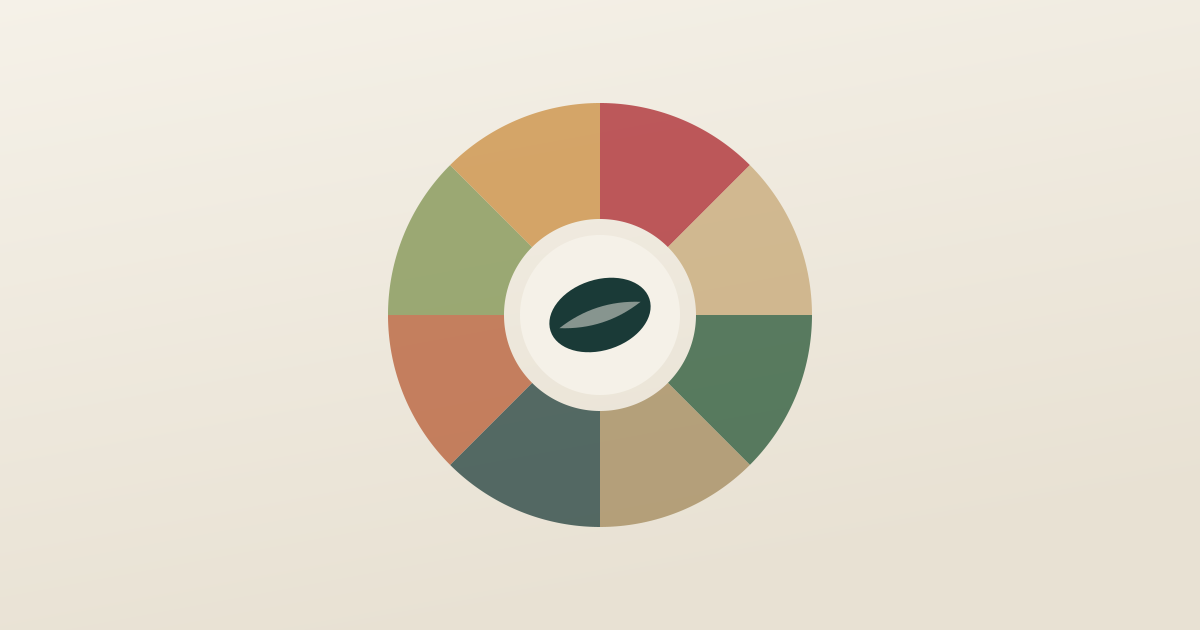
One of the best known is the Coffee Taster’s Flavor Wheel, created through work by the Specialty Coffee Association and World Coffee Research.
The underlying sensory lexicon provides a standardized vocabulary for describing coffee aroma, flavor, and texture.
The purpose is not to tell you what you must taste.
It is to create a shared language.
Why Can Two People Taste Different Things?
Sensory perception is personal.
A person who grew up eating mangoes may identify a mango-like aroma immediately, while someone with little experience with mango may simply describe the coffee as tropical or fruity.
Neither person is necessarily wrong.
Experience, memory, culture, food exposure, brewing conditions, and even temperature can affect the words we use to describe coffee.
Start With Broad Categories
You do not need to identify “white peach with jasmine and bergamot” on your first attempt.
Start simple.
Does the coffee remind you more of fruit, chocolate, nuts, spices, flowers, or roasted flavors?
If it seems fruity, ask another question.
Is it citrus-like? Berry-like? Tropical? Dried fruit?
You can gradually become more specific.
This is similar to the way the SCA Flavor Wheel moves from broad sensory categories toward more precise descriptors.
Temperature Changes What You Notice
Taste your coffee while it is hot.
Then taste it again as it cools.
You may be surprised.
Some delicate aromas become easier to identify at lower temperatures, while sweetness and acidity can also become more apparent.
That is why professional coffee evaluation does not rely on a single sip.
Processing Can Affect Tasting Notes
How coffee is processed after harvest can strongly influence what you experience.
Natural coffees may sometimes display intense fruit and fermented characteristics.
Washed coffees are frequently associated with clearer or more transparent profiles.
Other fermentation techniques can create even more distinctive results.
The coffee variety matters too.
Panama Geisha, for example, has become internationally known for distinctive floral and fruit-associated characteristics. World Coffee Research specifically notes the variety’s association with floral, jasmine, and peach-like aromas when well managed at elevation.
Do You Have to Taste What the Bag Says?
Absolutely not.
Tasting notes are guidance, not an exam.
If a bag says strawberry and you taste cherry, that does not mean you failed.
The most useful question is simply:
What does this coffee remind me of?
The more coffees you taste consciously, the easier that answer becomes.
And that is when coffee starts becoming much more than a morning routine.
It becomes a world of flavors waiting to be explored.


Comments
No comments yet. Be the first to add one.